
Yes, you can personalise a rental property in New Zealand; and more so than many tenants realise. Under sections 42A and 42B of the Residential Tenancies Act 1986, landlords cannot unreasonably withhold consent to minor changes, and withholding consent for a change that qualifies as ‘minor’ under the Act is an unlawful act. Minor changes include anything that presents a low risk of damage, can be easily returned to its original condition, and does not require a building consent.
Beyond the legal framework, there is a wide range of non-permanent decorating techniques including removable wallpaper, picture ledges, temporary adhesive hooks, and freestanding furniture that allow tenants to create a genuinely personalised space without touching the landlord’s walls or risking their bond. The key is knowing what requires consent, what does not, and how to document everything carefully from the start of the tenancy.
Table of Contents
How to Add Your Personal Touch While Respecting the Tenancy Agreement
Renting is how the majority of Wellington residents live. According to Stats NZ 2023 Census data, approximately 34% of New Zealand households rent their homes, and in Wellington City that proportion is significantly higher, with Stats NZ reporting the number of people renting a house in Central Wellington to be between 67-70%. For many Wellington renters, their rental property is not a temporary stopping point; it is where they live for years, raise children, and build daily life. The idea that a rental must feel institutional, bland, or impersonal is both outdated and, in many cases, legally incorrect.
The Residential Tenancies Act 1986, as amended in 2020 and 2024, gives tenants meaningful rights to personalise their rental space. At the same time, the tenancy agreement and the property’s condition at the start and end of the tenancy set clear parameters. Understanding where those parameters lie, and what you can do freely within them, is the starting point for creating a home that genuinely feels like yours.
This guide is designed for Wellington renters. It draws on 25 years of experience managing rental properties across the city and the wider region to give you practical, legally grounded advice on personalising your space, protecting your bond, and leaving the property in the same condition you found it, so that move-out day is smooth and your bond comes back in full.
“After 25 years in this market, the most common mistake we see from tenants is assuming they cannot do anything to personalise a rental without asking permission. In reality, a lot of what makes a home feel like home, rugs, plants, freestanding shelving, artwork on picture rails, curtains, good lighting, requires no consent at all. And for the things that do require consent, the law is genuinely more tenant-friendly than most people know.“
Raewyn Taylor, Co-Founder, Taylor Property Plus
DIY Decor: Using Non-Permanent Solutions Like Removable Wallpaper and Decals
The rental decorating market has grown substantially in recent years, driven by a global renter population that wants their home to look and feel like their own. The result is a wide and genuinely useful range of non-permanent products that deliver real visual impact without damaging walls, floors, or fixtures. Many of these products are now available in New Zealand through major home improvement retailers.
Removable Wallpaper and Peel-and-Stick Tiles
Removable or peel-and-stick wallpaper is one of the most transformative non-permanent decorating tools available. Applied correctly to a clean, dry surface, it adheres without damaging standard interior paint finishes and removes cleanly without leaving residue. It is available in a wide range of textures, patterns, and scales, from subtle linen effects to bold geometric prints, and can be used on feature walls, wardrobe interiors, stair risers, or behind shelving units to create a designed interior feel.
Peel-and-stick tile decals work on the same principle and are particularly effective in kitchens and bathrooms, where they can transform the appearance of a splashback or surround without adhesive, grout, or damage to existing tiles. New Zealand home improvement retailers stock an increasing range of these products. For curated recommendations and installation guidance, interior design resources such as Homes to Love NZ and NZ House and Garden regularly feature renter-friendly decorating ideas tested for the NZ market and climate.
Key application tips for removable wallpaper in a Wellington rental:
- Always test a small section first to confirm the product removes cleanly from your specific paint type and age.
- Clean and dry the wall surface thoroughly before application. Wellington’s humidity can affect adhesion, particularly in south-facing rooms.
- Apply from the top of the wall down, using a smoothing tool to eliminate bubbles.
- Keep the original packaging, which often includes manufacturer instructions for removal; useful documentation if questions arise at the end of the tenancy.
- Photograph the wall before application and after removal. This protects you if any adhesion issue arises with an older or unusual paint surface.
Command Strips, Adhesive Hooks, and Damage-Free Hanging
The most common source of end-of-tenancy bond deductions in Wellington is wall damage from picture hooks, screws, and nails. A well-placed command strip or adhesive hook can hold significant weight, including framed artwork, mirrors, floating shelves, and kitchen utensil rails, without drilling or nailing.
It is important to note, however, that adhesive products are not universally safe for all wall surfaces. New Zealand rentals use a variety of interior paint types, and some adhesive products interact poorly with particular paint finishes, particularly older enamel or low-VOC paints. Always check the weight limit of the product, follow the manufacturer’s removal instructions precisely (using the removal tab, not pulling the hook away from the wall), and test on a discreet area first.
For heavier items, picture rails, where present, are the renter’s best friend. Wellington’s older housing stock, particularly villas and bungalows in suburbs like Mount Cook, Thorndon, and Newtown, frequently retains original picture rails at cornice height. These allow artwork and mirrors to be hung with hooks and cord at any height, with no wall contact at all. If your rental has picture rails, use them freely; they are there for exactly this purpose.
Rugs, Curtains, and Textiles
Floor coverings, window treatments, and textiles require no consent, leave no mark, and have among the highest impact-to-effort ratios of any decorating approach. A large area rug can define a living space, add warmth and sound absorption, and protect an existing floor covering simultaneously. Quality curtains can replace or layer over builder’s standard window treatments (stored safely for return at the end of the tenancy) to add privacy, light control, and visual warmth.
For Wellington specifically, textiles also serve a functional purpose. Wellington’s cold, draughty winters make heavy curtains, draught stoppers, and layered rugs genuine comfort improvements, not just decorative ones. The Healthy Homes Standards require landlords to provide adequate draught stopping, but good curtains and rugs as a tenant supplement make a material difference to how warm and comfortable a rental feels through the city’s long, wet winter.
Plants and Greenery
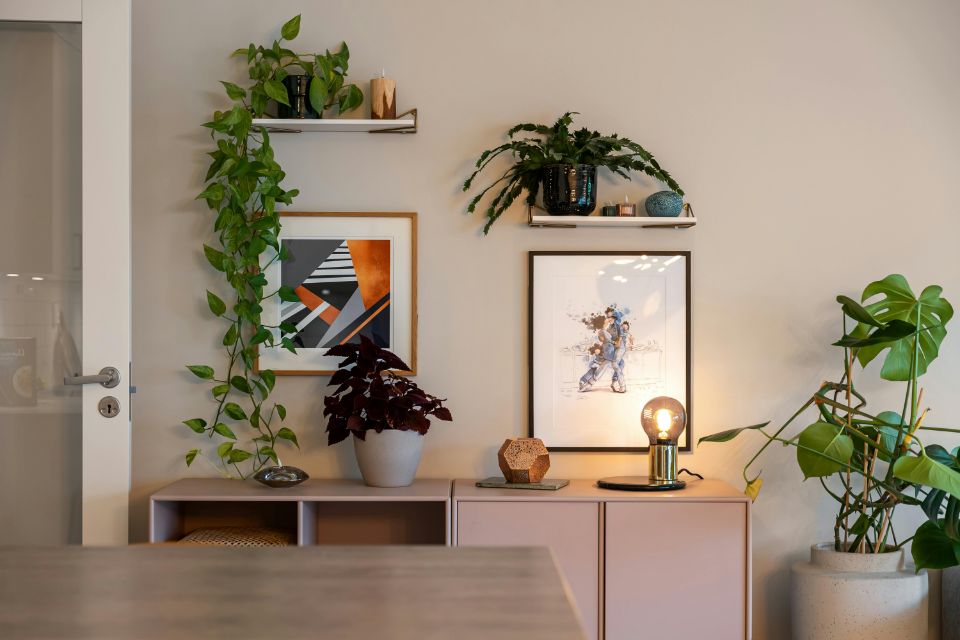
Indoor plants are one of the most effective and entirely permission-free ways to make a rental feel like a home. Research published in environmental psychology consistently finds that indoor greenery reduces stress, improves perceived air quality, and increases feelings of wellbeing and belonging in a space. For Wellington renters, plants also help manage indoor humidity, which is a genuine consideration in the city’s damp winters.
When choosing plants for a Wellington rental, consider the specific conditions of your space. South-facing rooms receive little direct sunlight; shade-tolerant species such as pothos, peace lily, and snake plant are well-suited. North-facing rooms with good light can support a wider range, including succulents and tropical species. Use saucers under all pots to protect floor surfaces, and be aware that large pots on timber decking can cause moisture damage if left in the same position for extended periods.
For Wellington-specific plant and outdoor space inspiration, see our related post on sustainable landscaping and eco-friendly outdoor spaces in Wellington rentals.
Maximising Space: Clever Storage and Furniture Arrangement Tips
Many Wellington rentals, particularly the villas, bungalows, and compact apartments that characterise the city’s inner suburbs, were not designed with the storage and open-plan layouts that modern tenants expect. Making the most of the space you have is as much a part of making a rental feel like home as any decorating choice.
Freestanding Storage Solutions
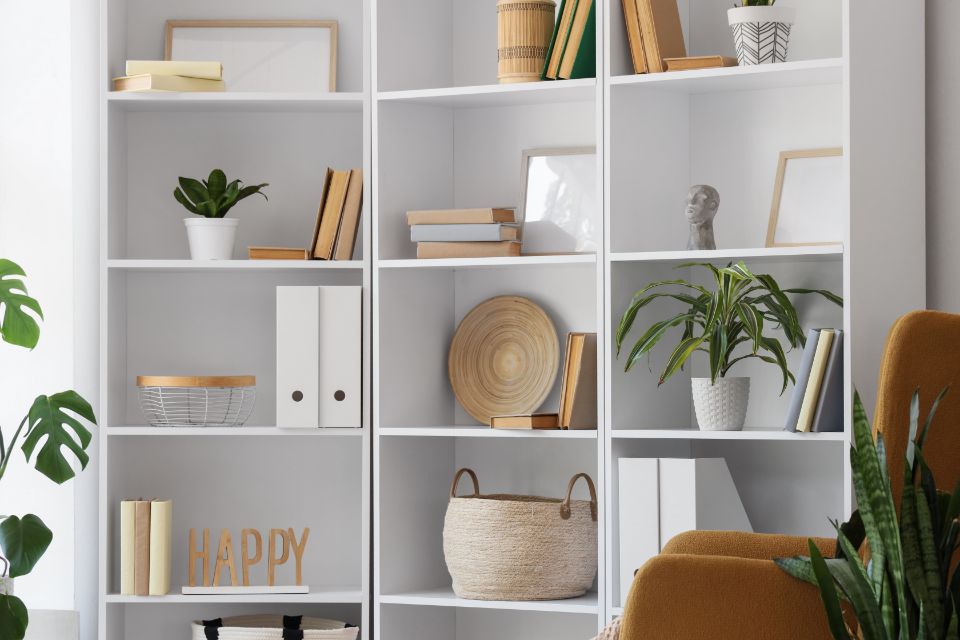
Freestanding shelving, bookcases, wardrobes, and storage units are the renter’s primary tool for adding storage without drilling into walls or fitting built-ins. Units from retailers such as Bunnings Wellington, IKEA NZ, and Mitre 10 Wellington provide a wide range of modular and freestanding storage options at different price points. The advantage of freestanding units is that they can be configured to the specific space, moved with you at the end of the tenancy, and adapted as your needs change.
For small Wellington apartments or rooms where floor space is limited, consider vertical storage: tall bookshelves that use wall height rather than floor area, over-door organisers, and stackable boxes or baskets. In kitchens, freestanding pot racks, magnetic knife holders (where the existing splashback material allows), and tiered organisers inside existing cupboards add meaningful functional storage without any fixed installation.
Furniture Arrangement for Light and Flow
Wellington’s older housing stock often has smaller rooms with fixed doors, windows, and fireplaces that constrain furniture arrangement. But working with the architecture of a space, rather than against it, can make a significant difference to how open and comfortable a room feels.
- Float furniture away from walls: In living areas, sofas and chairs arranged in a loose group around a rug, slightly away from the walls, tend to create a more intimate and designed feel than furniture pushed against the perimeter.
- Maximise natural light: In Wellington’s frequently overcast winters, placing reflective surfaces (mirrors, glass, metallic accents) opposite or adjacent to windows amplifies natural light significantly.
- Define zones in open-plan spaces: A rug, a freestanding shelving unit, or a sofa facing a specific direction can define a living zone, a dining zone, or a work-from-home space within an open-plan layout without any fixed division.
- Use mirrors strategically: A large mirror on a wall opposite a window effectively doubles the apparent depth of a room and significantly improves light. Full-length mirrors are entirely permission-free; leaning against a wall or propped on a mantelpiece, they require no fixings.
- Choose furniture that works harder: In compact Wellington rentals, pieces that serve multiple purposes, ottomans with storage, beds with integrated drawers, dining tables that extend, reduce clutter and increase functional space without adding footprint.
Lighting as a Transformative Tool
The fixed lighting in most Wellington rentals, standard overhead pendants or downlights, is rarely the most flattering or functional lighting for everyday living. Adding layered lighting through freestanding floor lamps, table lamps, and battery-powered LED strip lights or puck lights creates warmth, depth, and flexibility that an overhead fitting alone cannot. All of these are entirely permission-free, require no installation, and move with you at the end of the tenancy.
Battery-powered LED strip lights or clip-on spotlights are particularly useful in Wellington’s older kitchens and bathrooms, where under-cabinet or task lighting was not part of the original design. These require no wiring and no wall damage; just peel-and-stick or clip-on installation that leaves no trace.
Permission Required: Knowing What Modifications Need Landlord Consent
Understanding the legal framework for property modifications is essential for any Wellington tenant who wants to personalise their space confidently. The relevant law is sections 42A and 42B of the Residential Tenancies Act 1986, which have been in effect since February 2021.
What the Law Says: Minor Changes
Under section 42B of the Act, a landlord cannot unreasonably withhold consent to a minor change. More significantly: withholding consent for a change that qualifies as a minor change under the Act is an unlawful act; meaning a landlord who refuses can face a Tenancy Tribunal penalty. According to Tenancy Services NZ, a change qualifies as minor if it:
- presents no more than a low risk of material damage to the premises
- would allow the premises to be returned easily to substantially the same condition
- does not pose a risk to health and safety that cannot reasonably be eliminated or minimised
- does not compromise the structural integrity, weathertightness, or character of any building
- would not have an unreasonable negative effect on any person’s enjoyment of the property or neighbouring properties
- does not require any regulatory consent, such as a building consent
The Ministry of Housing and Urban Development’s guidance gives examples of minor changes that typically qualify: adding fire alarms, doorbells, curtains, baby-proofing, and similar low-impact modifications. A landlord must respond to a written request for a minor change within 21 days.
| Type of Modification | Consent Required? | Notes |
| Removable wallpaper, peel-and-stick tiles | No | No contact with substrate; fully reversible |
| Adhesive hooks and command strips | No (for standard use) | Follow weight limits and removal instructions carefully |
| Curtains on existing rods or tracks | No | Store original curtains safely and return at end of tenancy |
| Freestanding furniture and shelving | No | No fixings to walls or floor required |
| Plants, rugs, and textiles | No | Use saucers; protect floors from moisture |
| Picture hooks or small nails | Minor change: write to request | Typically qualifies as minor; request in writing first |
| Curtain rods or tracks (new installation) | Minor change: write to request | Low risk; typically qualifies as minor under s42B |
| Garden changes or planting (in existing beds) | Minor change: write to request | Must be reversible; consider tenant obligations in agreement |
| Painting walls a different colour | Consent required (s42A) | More than minor; landlord can impose reasonable conditions |
| Installing shelves with screws into walls | Consent required (s42A) | Write to request; landlord cannot unreasonably refuse |
| Installing a heat pump or air conditioner | Consent required; may need building consent | Significant modification; requires written consent and possibly a licensed installer |
| Any structural changes or rewiring | Consent required; building consent likely needed | Never do this without explicit landlord and council consent |
How to Request Consent for a Minor or Major Change
Tenancy Services provides a template form for requesting property changes, available at tenancy.govt.nz. Your request should be in writing (email is fine), describe the proposed change clearly, explain why you want it, and confirm your understanding that you will return the property to its original condition unless otherwise agreed. Send the request to your property manager or landlord directly and keep a copy. The landlord or property manager must respond in writing within 21 days.
If you want a minor change to remain permanently (for example, you plan to repaint and want the new colour to stay), you can request this in your initial consent letter. The landlord is not obligated to agree to this, but many will if the change improves the property’s presentation and the colour scheme is neutral and well-executed.
“What we see most often is tenants who wanted to do something completely reasonable but assumed they needed permission and never asked, or tenants who made changes they were legally entitled to make but did not document anything. Either way, the lack of communication is what creates problems at the end of a tenancy. Our advice is always the same: if in doubt, ask in writing. A good property manager will give you a clear answer quickly, and most reasonable requests for minor changes are approved without any difficulty.“
Kelvin Taylor, Co-Founder & Director, Taylor Property Plus
Leaving It Better Than You Found It: Making Responsible Decisions for a Smooth Move-Out
The single most important principle for any personalisation you undertake in a rental is this: plan for removal from the moment you install. Every decorating choice should be made with a clear understanding of how it comes out and what the wall, floor, or surface will look like when it does. This is not a counsel of caution; it is simply practical planning that protects your bond and your relationship with your property manager.
The Entry Inspection Report Is Your Most Important Document
Before you add anything to a rental property, read and photograph everything in your entry inspection report. This report documents the property’s condition at the start of the tenancy and is the baseline against which the final inspection will assess your bond. If something was already marked or damaged before you moved in, make sure it is in the report; if it is not, add a written note to the landlord or property manager within the first few days of the tenancy and keep a copy.
This is also the document that protects you if a landlord attempts to claim for pre-existing conditions at the end of the tenancy. The entry inspection report, your photographs from day one, and your exit-day photographs together create a clear, dated, visual record that any Tenancy Tribunal adjudicator will rely on. For more on the final inspection process and bond protection, see our tenant-focused post on what to expect from the final inspection, and on your essential responsibilities for maintaining your rental property in Wellington.
A Responsible Move-Out Decorating Checklist
- Remove all removable wallpaper and adhesive products carefully following manufacturer instructions. Never pull adhesive products straight off a wall; use the removal tab or heat to release the adhesive slowly.
- Clean walls after any adhesive product removal. A small amount of residue is common; most can be removed with a damp cloth or isopropyl alcohol.
- Return any original fixtures. If you replaced a shower curtain, light fitting, or curtain set for the tenancy, reinstall the original before departure.
- Fill any small holes you did make, even with consent. Use appropriate filler, sand smooth, and touch up with paint that matches the existing wall colour. Many Wellington hardware stores stock sample paint pots.
- Reverse any minor changes you made under section 42A or 42B, unless you negotiated otherwise in writing. Your obligation under the Act is to return the property to substantially the same condition as before the minor change was made.
- Document everything on move-out day. Take dated photographs of every room, every wall, and every fixture before you hand back the keys.
- Request a pre-move-out inspection. Most professional property managers, including the Taylor Property Plus team, offer a walk-through a week or so before the tenancy ends to identify any issues you can address before the formal final inspection.
The Repainting Question
Repainting is one of the most transformative things a tenant can do to a rental and one of the most frequently requested permissions. If you have obtained consent to repaint, the conditions typically include using a specific colour range (or returning to the original colour at tenancy end), using a professional painter or achieving a professional standard of finish, and not painting over features such as wallpaper, timber panelling, or heritage details.
If you painted with consent and the landlord has agreed the colour can remain, get that agreement in writing. If you are expected to return the walls to the original colour, factor the cost of repainting back into your tenancy plan, as professional painting of a standard Wellington three-bedroom house costs $3,000 to $6,000 or more depending on surface area and condition. Attempting to repaint walls yourself without experience can produce a result that is worse than the original, which creates both an aesthetic issue and a potential bond dispute.
“Tenants who have genuine conversations with their property manager about what they want to do, who document the property properly at the start, and who plan their move-out from the beginning almost never have bond disputes. The disputes we see at the end of a tenancy are almost always about things that were never discussed, changes that were made without consent or that were not reversed, or damage that a tenant hoped would not be noticed. Transparency is always the better strategy.“
Tim Taylor, Director, Taylor Property Plus
A Wellington Renter’s Quick Reference: Personalising Your Space by Room
| Room | High-Impact, Low-Risk Personalisation Ideas |
| Living room | Large area rug to define the space; freestanding bookcase or sideboard; layered floor and table lamps; plants; artwork hung on picture rails (if present) or propped on shelves; removable wallpaper on a feature wall; mirrors opposite windows to amplify light |
| Kitchen | Peel-and-stick tile decals on existing splashback; battery-powered LED strip lights under upper cabinets; freestanding pot rack or magnetic knife strip (on existing tiles); colourful appliances, teapots, and dishes for visual interest; herbs on a sunny windowsill |
| Bedroom | Quality bedlinen and cushion layers; bedside tables with table lamps; full-length mirror leaning against wall or hung with adhesive; removable wallpaper or decal behind the bed as a headboard effect; freestanding wardrobe or clothing rack for extra storage |
| Bathroom | Quality towels and bath mat; bamboo or timber accessories (soap dish, toothbrush holder, storage box); shower curtain upgrade over existing rail; peel-and-stick tile decals on existing tiles; bathroom shelf organiser within existing cabinet; plant (peace lily or fern suits bathroom humidity) |
| Home office | Freestanding desk and quality ergonomic chair; monitor arm on desk (no wall drilling); desk lamp; a pinboard leaning against the wall (not fixed to it); plants; a rug to define the zone in a shared space; cable management along existing skirting with adhesive cable clips |
| Outdoor spaces | Outdoor furniture; pots and container planting (moveable); string lights on a freestanding structure or clipped to existing fence; outdoor rug; raised garden beds (freestanding); bird feeder; a portable fire bowl (subject to Wellington wind conditions and tenancy agreement terms) |
For more inspiration on upgrading your rental space, see our posts on decorating hacks for renters: personalising without losing your bond and tenant-led upgrades: what modern renters really want in 2026.
“The best tenants we have worked with over 25 years in Wellington are the ones who treat their rental like it is their home; because it is. They take pride in the space, they invest in it with their own furniture and decor, and they hand it back in the same condition they found it. That combination of care and respect is what makes a tenancy work well for everyone. You do not need to own a property to make it feel like yours.“
Samuel Taylor, Managing Director, Taylor Property Plus
Frequently Asked Questions
Can I put up pictures in my rental in New Zealand?
Yes, with some nuance. Using adhesive hooks and command strips requires no consent and no drilling, and is the safest approach for bond protection. If you want to use small picture hooks or nails, this is generally considered a minor change under section 42B of the Residential Tenancies Act 1986. You should request this in writing to your landlord or property manager before proceeding; a landlord cannot unreasonably refuse a request for a minor change, and doing so is an unlawful act. At the end of the tenancy, you are expected to fill and touch up any small holes made, returning the walls to substantially their original condition.
Can I use removable wallpaper in a rental property?
Yes. Removable or peel-and-stick wallpaper does not damage standard interior paint surfaces when applied and removed correctly, and requires no landlord consent. Apply to a clean, dry surface, follow the manufacturer’s removal instructions carefully, and test on a small, discreet area first to confirm compatibility with your specific wall paint. Photograph the wall before application and after removal as part of your personal documentation.
Do I need to ask my landlord before painting a rental?
Yes. Painting walls is not a minor change under the Residential Tenancies Act; it requires the landlord’s written consent under section 42A. A landlord cannot unreasonably withhold consent, but they can impose reasonable conditions, such as specifying a colour range or requiring the walls to be repainted to the original colour before the tenancy ends. If consent is given and you agree that the new colour can remain, document that agreement in writing. For neutral, well-executed colour choices, many landlords are willing to agree; a fresh coat of paint in a good colour often improves the property’s presentation and rental appeal.
What counts as a minor change in a NZ rental property?
Under section 42B of the Residential Tenancies Act 1986, a minor change is any fixture, renovation, alteration, or addition that: presents no more than a low risk of material damage; can be easily returned to its original condition; does not pose a health and safety risk; does not affect the structural integrity or weathertightness of the building; does not require a building or regulatory consent; and does not negatively affect neighbouring properties. Examples given in Ministry of Housing and Urban Development guidance include adding curtains, fire alarms, doorbells, and baby-proofing. A landlord who withholds consent for a change that qualifies as minor under these criteria commits an unlawful act under the Act. For the full legal text, see Tenancy Services NZ.
How do I protect my bond when decorating a rental?
The most reliable bond protection strategies are: photograph the property thoroughly on day one of the tenancy and compare your photographs against the entry inspection report; use non-permanent decorating products (removable wallpaper, adhesive hooks, freestanding furniture) wherever possible; request consent in writing before any modification that is not clearly non-permanent; document all modifications with before-and-after photographs; reverse all changes at the end of the tenancy and return the property to substantially its original condition; and request a pre-move-out inspection to identify any issues before the formal final inspection. For a full guide to the final inspection process, see our post on what to expect from the final inspection.
Can a landlord refuse to let me personalise my rental in New Zealand?
For changes that qualify as minor under section 42B of the Residential Tenancies Act 1986, a landlord cannot lawfully refuse consent. For changes that are more than minor (such as painting, installing shelves with screws, or adding new fixtures), a landlord cannot unreasonably refuse consent. A landlord who does refuse must do so in writing within 21 days of receiving a written request. If you believe a refusal is unreasonable, you can apply to the Tenancy Tribunal for a resolution. For guidance on your rights as a tenant, Tenancy Services NZ at tenancy.govt.nz or 0800 836 262 (0800 TENANCY) is the primary authoritative source.
Where can I buy renter-friendly decorating products in Wellington?
Wellington has a good range of home improvement and homewares retailers stocking renter-friendly products. For hardware and DIY supplies including adhesive hooks, command strips, and cable management products, Bunnings Wellington and Mitre 10 Wellington are the major options. For furniture and storage, IKEA NZ (online and Westgate, Auckland, with nationwide delivery) provides modular, renter-adaptable furniture ranges. The Warehouse, Kmart, and trade stores on Cuba Street and Tory Street offer affordable textiles, rugs, and accessories. For removable wallpaper specifically, online retailers including Rebel Walls NZ, A-Street Prints (via NZ stockists), and Tempaper ship to Wellington addresses. Interior design inspiration tailored to the NZ market is well covered by Homes to Love NZ and NZ House and Garden.
A Final Note from the Taylor Property Plus Team
Making a rental feel like home is not just about aesthetics; it is about wellbeing, stability, and the sense of ownership over the space in which you live your daily life. Research in environmental psychology consistently finds that people who feel connected to and proud of their living space experience better mental health outcomes, lower stress, and higher satisfaction with their housing overall. For the many Wellington residents who rent long-term, this matters.
The legal framework in New Zealand genuinely supports renters’ right to personalise their space. The practical tools available for non-permanent decorating are better than they have ever been. And professional property management, done well, should make it easier, not harder, to have open conversations about what you want to do with your home.
If you are renting a property managed by Taylor Property Plus and have a question about a modification you would like to make, please contact your property manager directly. We are always happy to discuss requests and provide a written response promptly. For authoritative guidance on your rights to make changes to a rental property, Tenancy Services NZ at tenancy.govt.nz provides the most current and comprehensive information. And for a full picture of all the related topics covered in this post, see our complete guide to from renovation to rental, which covers the landlord’s perspective on property upgrades and how good maintenance benefits everyone in a tenancy.